


Overview
Nighttime white balance as sequential decision-making

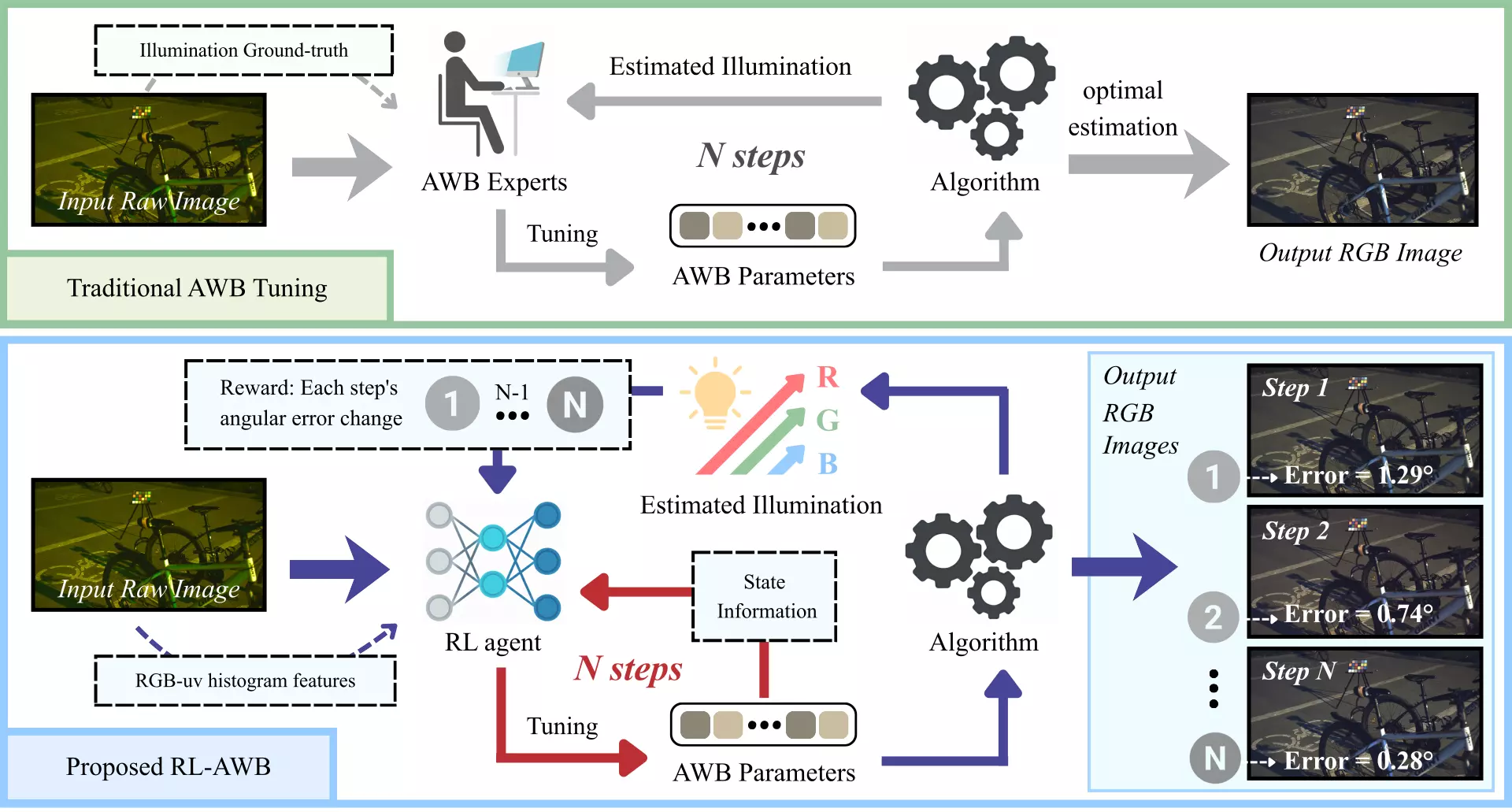
Nighttime color constancy remains a challenging problem in computational photography due to low-light noise and complex illumination conditions that limit cross-sensor generalization. We present RL-AWB, a novel framework combining statistical methods with deep reinforcement learning for nighttime white balance. Our method begins with a statistical algorithm tailored for nighttime scenes, integrating salient gray pixel detection with novel illumination estimation. Building on this foundation, we develop the first deep reinforcement learning approach for color constancy that leverages the statistical algorithm as its core, mimicking professional AWB tuning experts by dynamically optimizing parameters for each image without knowing its ground-truth illumination. To facilitate cross-sensor evaluation, we introduce the first multi-sensor nighttime color constancy dataset. Experiment results demonstrate that our method achieve superior generalization capability across low-light and well-illuminated images.
What this work contributes
- We develop SGP-LRD (Salient Gray Pixels with Local Reflectance Differences), a nighttime-specific color constancy algorithm that achieves state-of-the-art illumination estimation on public nighttime benchmarks.
- We design the RL-AWB framework with Soft Actor-Critic (SAC) training and two-stage curriculum learning, enabling adaptive per-image parameter optimization with exceptional data efficiency.
- We contribute LEVI (Low-light Evening Vision Illumination), the first multi-camera nighttime dataset comprising 700 images from two sensors, enabling rigorous cross-sensor color constancy evaluation.
- Extensive experiments demonstrate superior cross-sensor generalization over state-of-the-art with only 5 training images per dataset.
Method
RL-AWB
A Soft Actor-Critic agent observes illumination- and parameter-related features, then iteratively adapts SGP-LRD for each image.

Adaptive process
Correction improves step by step
The complete trajectory shows the raw input, SGP-LRD initialization, three RL updates, and the corresponding illuminant path.
Images are gamma-corrected for visualization.


Dataset
The LEVI dataset
700 nighttime RAW images from two camera systems, with manually annotated ColorChecker masks for cross-sensor evaluation.
Images are gamma-corrected for visualization.


Qualitative
Compare corrections, method by method
Select a method to compare its corrections across all four scenes. Reported numbers are angular errors in degrees.
Images are gamma-corrected for visualization.
Scene 01


Scene 02


Scene 03


Scene 04


Quantitative
Results
Evaluation of the statistical-based methods on both NCC and LEVI datasets. Angular error in degrees.
Cells highlighted as 1st / 2nd / 3rd per column.
| Method | NCC | LEVI | ||||||||
|---|---|---|---|---|---|---|---|---|---|---|
| Med. | Mean | Tri. | B-25 | W-25 | Med. | Mean | Tri. | B-25 | W-25 | |
| GE-1st | 4.14 | 5.17 | 4.35 | 1.25 | 10.87 | 3.94 | 4.31 | 3.97 | 1.82 | 7.45 |
| GE-2nd | 3.58 | 4.64 | 3.78 | 1.11 | 9.93 | 4.17 | 4.49 | 4.19 | 1.80 | 7.76 |
| MSGP | 2.48 | 3.52 | 2.70 | 0.80 | 8.02 | 3.12 | 3.34 | 3.14 | 1.54 | 5.52 |
| GI | 3.13 | 4.52 | 3.40 | 0.91 | 10.60 | 3.10 | 3.42 | 3.15 | 1.49 | 5.91 |
| BCC | 3.06 | 3.81 | 3.23 | 1.05 | 7.78 | 4.23 | 4.53 | 4.28 | 2.52 | 7.06 |
| RGP | 2.22 | 3.33 | 2.44 | 0.68 | 7.81 | 3.21 | 3.56 | 3.29 | 1.63 | 6.12 |
| SGP-LRD (Ours) | 2.12 | 3.11 | 2.29 | 0.68 | 7.22 | 3.08 | 3.25 | 3.07 | 1.40 | 5.46 |
Cross-dataset evaluation of the learning-based methods between NCC and LEVI datasets. All learning-based baselines are implemented using three-fold cross-validation protocols and trained on the complete dataset.
Cells highlighted as 1st / 2nd / 3rd per column.
| Train → Test | NCC → LEVI | LEVI → NCC | ||||||||
|---|---|---|---|---|---|---|---|---|---|---|
| Method | Med. | Mean | Tri. | B-25 | W-25 | Med. | Mean | Tri. | B-25 | W-25 |
| FC4 | 11.8 | 12.3 | 11.9 | 6.36 | 19.2 | 13.2 | 14.4 | 13.8 | 6.17 | 24.1 |
| FFCC | 4.44 | 7.12 | 5.17 | 1.96 | 16.7 | 7.54 | 8.51 | 7.60 | 4.36 | 14.8 |
| C4 | 3.09 | 3.47 | 3.18 | 1.18 | 6.37 | 5.85 | 6.73 | 6.04 | 2.86 | 12.2 |
| C5 | 9.12 | 11.7 | 9.85 | 3.76 | 23.4 | 4.47 | 5.46 | 4.68 | 1.70 | 10.9 |
| PCC | 11.1 | 12.5 | 11.7 | 7.36 | 19.7 | 8.96 | 10.4 | 9.35 | 6.24 | 16.7 |
| GCC | 28.1 | 43.0 | 40.5 | 12.2 | 90.0 | 9.77 | 41.1 | 28.1 | 2.26 | 90.0 |
| ePCC | 9.64 | 10.2 | 9.72 | 7.04 | 14.6 | 7.89 | 8.93 | 8.17 | 5.46 | 14.0 |
| RL-AWB (Ours) | 3.03 | 3.24 | 3.04 | 1.45 | 5.36 | 1.99 | 3.12 | 2.25 | 0.67 | 7.39 |
Evaluation results on Gehler-Shi dataset trained on NCC dataset. FC4, C4, C5, PCC, GCC, ePCC and the proposed RL-AWB are trained on NCC dataset and evaluated on Gehler-Shi dataset. Compared with our SGP-LRD, the proposed RL-AWB framework achieves a reduction of 5.9% in the median angular error and 9.8% in the best-25% angular error, showing that RL-AWB generalizes well across low-light and well-illuminated images.
Cells highlighted as 1st / 2nd / 3rd per column.
| Method | Med. | Mean | Tri. | B-25 | W-25 |
|---|---|---|---|---|---|
| FC4 | 13.8 | 15.8 | 14.6 | 6.38 | 18.8 |
| C4 | 5.62 | 6.52 | 5.84 | 2.43 | 12.0 |
| C5 | 3.34 | 3.97 | 3.43 | 1.32 | 7.80 |
| PCC | 4.97 | 8.50 | 6.07 | 1.64 | 20.9 |
| GCC | 8.44 | 20.2 | 9.68 | 3.06 | 58.9 |
| ePCC | 3.93 | 5.16 | 4.17 | 2.00 | 10.5 |
| SGP-LRD (Ours) | 2.38 | 3.64 | 2.64 | 0.51 | 8.89 |
| RL-AWB (Ours) | 2.24 | 3.50 | 2.51 | 0.46 | 8.67 |

Qualitative comparison of cross-dataset performance. Angular error in degrees. Note that images shown are gamma-corrected for visualization.
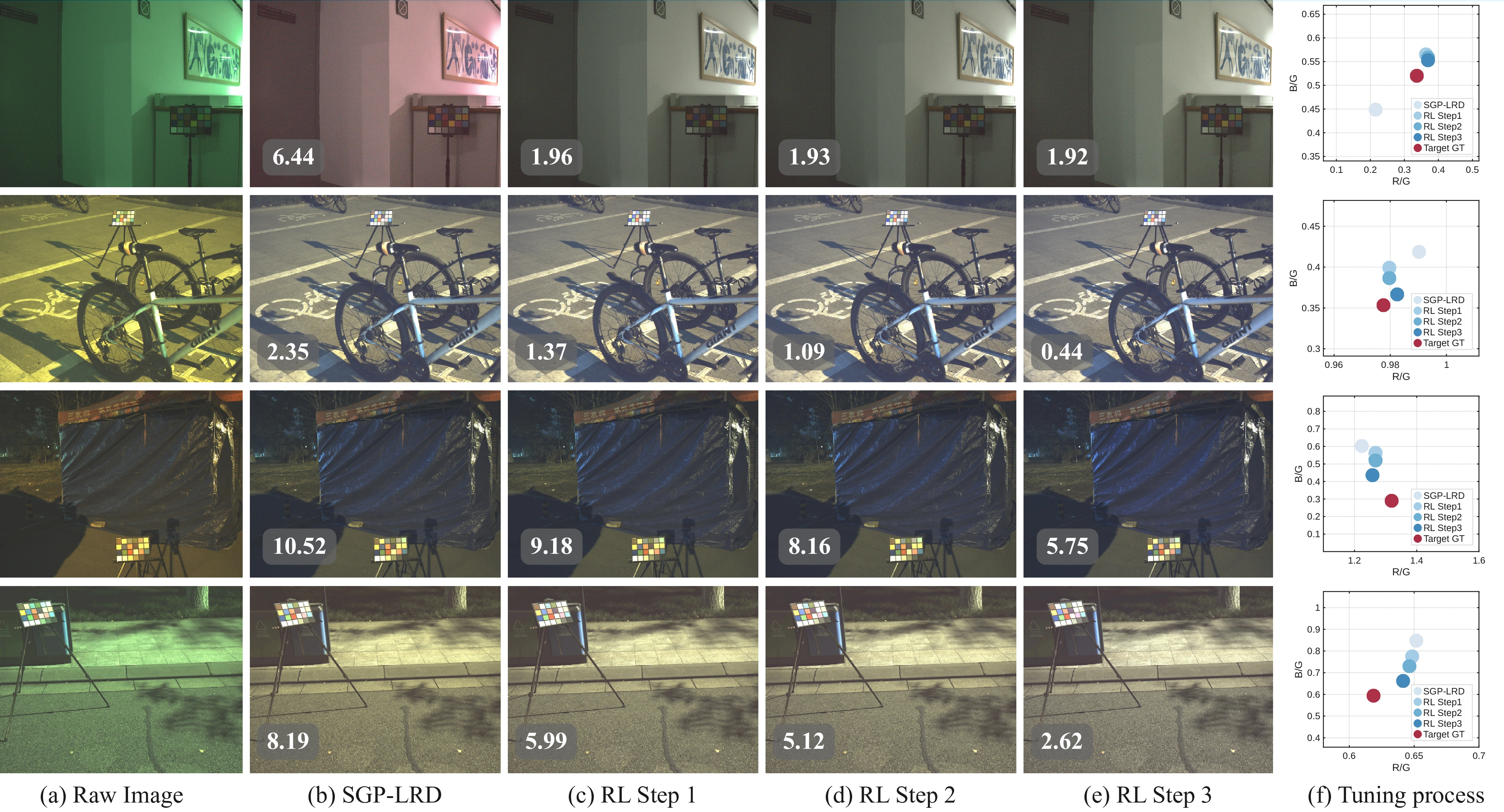
Qualitative comparison of cross-dataset performance. Angular error in degrees. Note that images shown are gamma-corrected for visualization.
Citation
BibTeX
@inproceedings{lee2026rl,
  title={RL-AWB: Deep Reinforcement Learning for Auto White Balance Correction in Low-Light Nighttime Scenes},
  author={Lee, Yuan-Kang and Chen, Kuan-Lin and Chang, Chia-Che and Liu, Yu-Lun},
  booktitle={European Conference on Computer Vision},
  pages={77--99},
  year={2026},
  organization={Springer}
}